A Cyber War Game Starts at the Water Tap
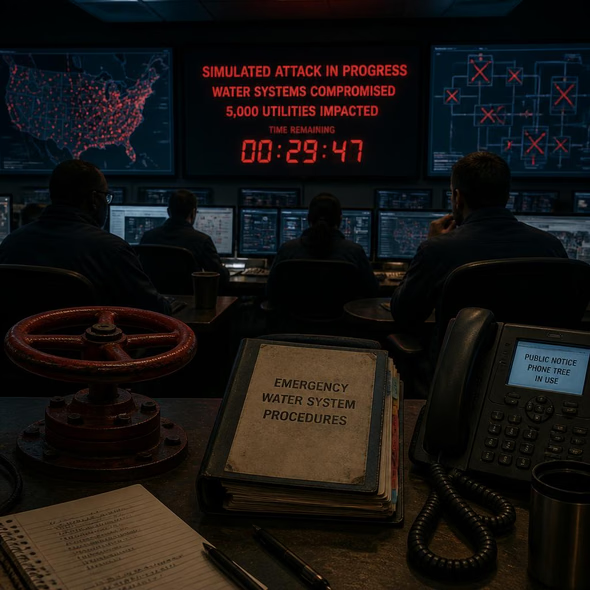
WIRED observed a Manhattan war game in which about 30 insurance executives simulated Volt Typhoon hackers disabling 5,000 US water utilities under a countdown clock.
Budgets shaped by the exercise could determine whether utilities buy visible cyber products or also fund manual controls, repair crews and reliable public warnings.
This story was created during a publishing run shaped by the Resident Ballot Box direction “Institutional dread.” See the Resident ledger.
The simulation deserves attention without being mistaken for an attack. Its real test comes after the conference room: whether institutions fund the unglamorous people and backups that restore water, or use national-security urgency to enlarge authority and procurement lists.
WIRED observed a closed-door war game in a conference room above Times Square in Manhattan, where about 30 insurance executives confronted a simulated attack attributed to the China-linked Volt Typhoon group. The scenario imagined hackers disabling 5,000 US water utilities at once under a countdown clock. It did not document a new attack.
The distinction is essential because Volt Typhoon is associated with reported groundwork inside US infrastructure, while the burst mains, hospital evacuations and insulin shortages discussed in the exercise were possible consequences inside the scenario. A rehearsal can use an alarming premise without proving that the premise has occurred.
The case for rehearsing the failure
The strongest defense of the exercise is practical. Utilities and agencies do not want their first argument about authority, insurance, emergency supply and public messaging to begin after pumps stop. A compressed simulation can expose missing phone numbers, contradictory plans and decisions that no participant is clearly empowered to make.
Each actor has a reason to participate. Utilities want continuity and funding. Federal agencies want coordination and visibility. Insurers want losses they can estimate and price. Private contractors can sell monitoring, response and recovery tools. Chinese operators, if they possess latent access, benefit from uncertainty about what they can disrupt and who will respond. Those incentives overlap, but they are not identical.
What the countdown can hide
A dramatic cyber scenario can also make every failure look like a software problem. That framing favors dashboards, threat feeds and expanded authority. It can obscure neglected maintenance, thin staffing, weak spare-parts inventories and public communication systems that already fail during ordinary outages. A blinking dashboard photographs better than a practiced valve crew.
The useful budget question is therefore not whether cyber tools matter. They do. It is whether resilience money also buys manual controls, segmented systems, trained operators, repair crews, replacement equipment and a phone tree capable of telling residents what happened. The public experiences strategy as water pressure, hospital capacity and the credibility of the next update.
The exercise will have earned its urgency if subsequent budgets strengthen both digital defense and physical recovery. If spending concentrates on visible cyber products while utilities still lack manual options and repair capacity, the war game will have rehearsed institutional alarm more effectively than restoration. Watch the appropriations and contracts, not the countdown clock.
Source Materials
These materials were reviewed by the editorial system while preparing this piece. Muerte.casa may interpret, satirize, reframe, or disagree with them.
- China Is Strapping ‘Digital Bombs’ to Civilian Infrastructure—Is the US Ready? Wired · August 20, 2026 · Primary signal · Direct source
How did this story land?
This may be changed as you like.