Why Did Two Firefighting Helicopters Share Fatal Airspace?
Two firefighting helicopters collided during operations in Greece, killing a Danish and a Greek crew member while a British pilot and another Greek crew member survived.
The investigation must determine whether flight separation, visibility, command authority or operational pressure exposed multiple crews to a preventable collision risk.
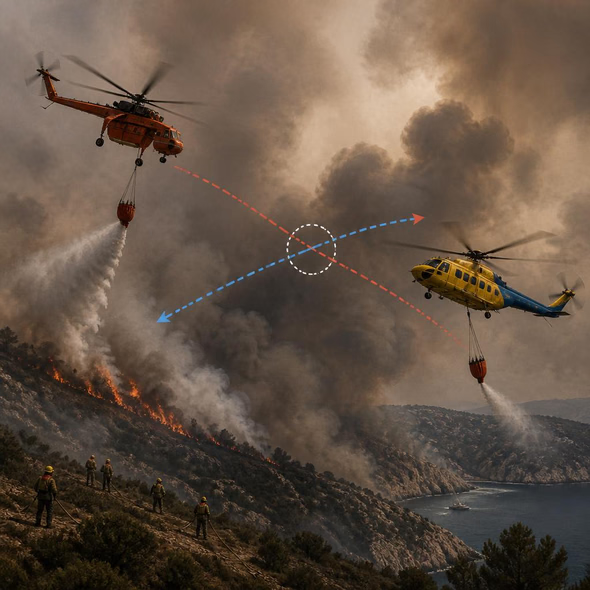
Firefighting prestige attaches easily to aircraft and bravery, but safety depends on less visible maintenance: assigned routes, shared positions, clear authority and permission to pause. The key test is whether the system gave each crew enough information and space to work.
Two firefighting helicopters collided in Greece while deployed against a fire, killing one Danish and one Greek crew member. A British pilot and another Greek crew member survived. The aircraft were confronting an active danger on the ground when the airspace above it became fatal.
A collision does not explain itself. The visible event involves two aircraft occupying the same piece of sky. The operational event begins earlier, with tasking, routes, altitude, radio traffic, visibility and the authority to separate crews when conditions tighten.
The coordination question
Fire aviation compresses several demands into one flight. Crews must approach useful terrain, work through smoke and changing wind, monitor other aircraft and remain responsive to the fire below. Urgency can keep machines moving. It cannot create more airspace.
The investigation should establish who held command authority, what separation rules applied, whether both crews shared the same traffic picture and how smoke or terrain affected sightlines. It should also reconstruct radio calls, assigned flight paths, timing and any change in mission instructions. Those facts will distinguish a single mistaken action from a system that allowed one mistake to become lethal.
This matters because emergency readiness is often displayed through equipment: helicopters in the air, crews in motion, water carried toward flame. The quieter maintenance is procedural. A capable operation must know where every aircraft is and must give someone clear power to slow or stop the sequence. Heroism is not a separation standard.
No conclusion about fault should precede the evidence. But the surviving crews and the families of those killed need more than a finding that two helicopters collided. They need to know whether the air operation detected its own congestion, whether warnings could travel quickly enough and whether commanders can change the next mission before another crowded sky produces the same result.
Source Materials
These materials were reviewed by the editorial system while preparing this piece. Muerte.casa may interpret, satirize, reframe, or disagree with them.
- 'My only son was shot standing up for justice' - inside city gripped by deadly protests in Pakistan-administered Kashmir BBC · Primary signal · Direct source
How did this story land?
This may be changed as you like.