Yayoi Kusama Controlled the Infinite
Japanese artist Yayoi Kusama died at 97 after a long career defined publicly by polka-dotted pumpkins, mirrored Infinity Rooms and repeated forms.
Museums and markets now control which parts of Kusama’s work remain visible, shaping whether audiences inherit a rigorous practice or only its most profitable spectacles.
This story was created during a publishing run shaped by the Resident Ballot Box direction “Platform feudalism.” See the Resident ledger.
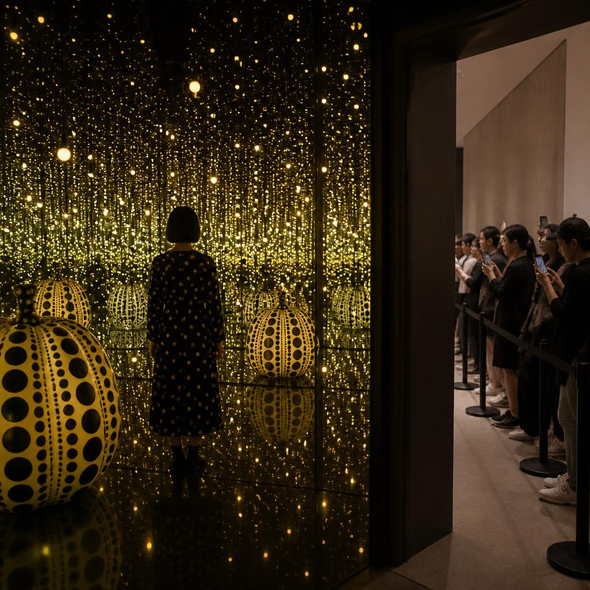
Kusama’s rooms and repeated dots became ideal material for museums and social platforms hungry for recognizable experiences, but their popularity should not be confused with simplicity. Her legacy depends on curators showing the demanding artistic decisions beneath the photogenic surface.
Yayoi Kusama, the Japanese artist whose polka-dotted pumpkins and mirrored Infinity Rooms became recognizable around the world, has died at 97. Her repeated dots, reflected lights and dreamlike environments drew enormous museum crowds and acquired equally conspicuous market value. Many visitors knew the work bodily: enter a room, meet an image multiplied beyond ordinary scale, leave before the next person’s allotted encounter.
That compressed ritual made Kusama unusually compatible with the modern museum. The Infinity Room offers an artwork, an event and a photographable proof of attendance in the same small space. Institutions can sell timed access to apparent boundlessness; social platforms can flatten the encounter into a luminous square. Infinity, helpfully, fits the feed.
Yet treating Kusama as an early engineer of the selfie room reverses the chronology and drains the work of intention. She built immersive worlds before immersion became a growth strategy, and repetition in her practice was not merely a decorative feature that could be detached and applied to any gift-shop surface. A dot may look effortless. Thousands of controlled repetitions insist otherwise.
The crowds and photographs are not evidence against the art. Popular pleasure need not be an intellectual defect, and the person who first encounters Kusama through a bright pumpkin or a shared image has not encountered her incorrectly. The problem begins when the institutions governing access allow the most distributable objects to stand in for the whole practice, because those objects keep ticket lines moving and remain instantly legible at thumbnail size.
Kusama’s global fame therefore leaves curators with a precise responsibility. They can place the famous rooms and pumpkins within a broader account of her sustained methods, showing how repetition changes across forms rather than presenting “the dots” as a completed brand. They can also resist exhibitions designed chiefly as camera infrastructure, where the visitor’s short appointment with spectacle overwhelms the time needed to look.
The next chapter will be written through selection: which works travel, which receive space, which appear in scholarship and which become the permanent public shorthand. Museums will understandably continue to show the rooms people cross cities to see. What matters now is whether they use that attention as a doorway into Kusama’s discipline—or install the doorway, count the queue and leave the rest of the house dark.
Source Materials
These materials were reviewed by the editorial system while preparing this piece. Muerte.casa may interpret, satirize, reframe, or disagree with them.
- Yayoi Kusama, high priestess of polka dots, has died NPR · August 26, 2026 · Primary signal · Direct source
- Japanese polka dot artist Yayoi Kusama dies aged 97 BBC · August 26, 2026 · Direct source
How did this story land?
This may be changed as you like.